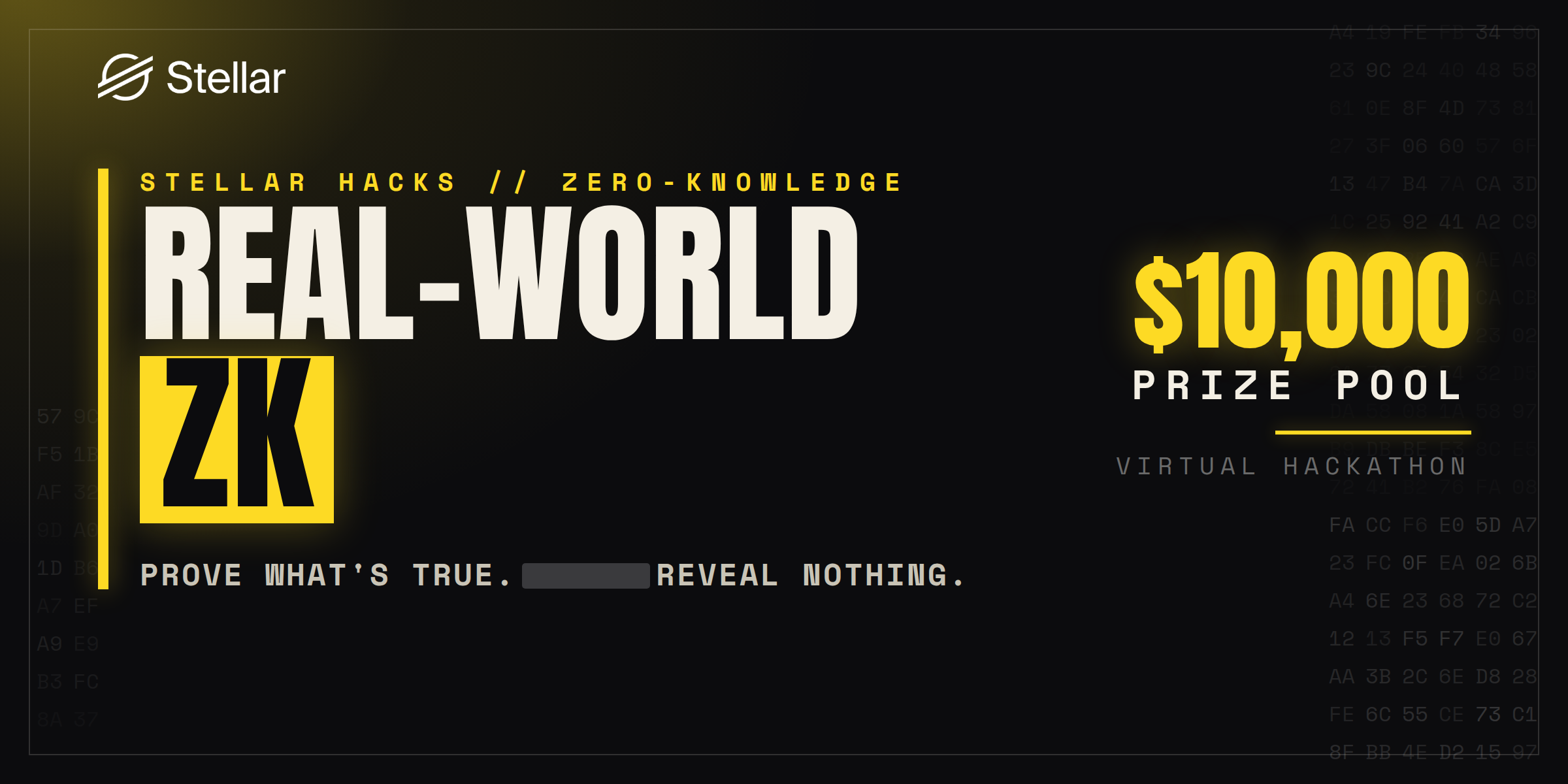
Stellar Hacks: Real-World ZK
# Stellar Hacks: Real-World ZK
 Organizer Stellar Development Foundation
Ends · remaining
About this hackathon
# Stellar Hacks: Real-World ZK
### Real-World ZK on Stellar
This hackathon is wide open: **build anything you want with zero-knowledge on Stellar.** Privacy pools, private payments, confidential tokens, identity and compliance proofs, provable computation, verifiable data — if it uses ZK and runs on Stellar, it counts. You can go anywhere on the spectrum from *mild* (a clean proof-of-concept verifier) to *wild* (a full shielded payment app).
Stellar is best known for moving real money in the real world — stablecoins, cross-border payments, tokenized real-world assets, and institutional settlement. So projects that bring ZK to those kinds of real-world use cases are a natural fit and especially welcome. But that's a suggestion, not a requirement. A clever ZK demo, a niche privacy tool, or an experiment that just makes you curious is equally valid as long as ZK is doing real work in it (not just namechecked in the README).
We're running this now because Stellar has spent the last few protocol releases building out the cryptographic foundation that modern ZK systems need. **Protocol 25 ("X-Ray")** introduced native host functions for ZK-friendly primitives — BN254 elliptic-curve operations and Poseidon/Poseidon2 hashing — and **Protocol 26 ("Yardstick")** built on that with nine additional BN254 host functions (multi-scalar multiplication, scalar-field arithmetic, and curve-membership checks), moving heavy ZK math into the host layer and making proof verification — including NoirLang proofs — meaningfully cheaper to run on-chain. Combined with BLS12-381 from earlier protocols, Stellar now has the on-chain building blocks to verify zk-SNARK proofs efficiently and affordably.
A note worth setting expectations on: these primitives are **building blocks.** They don't, by themselves, give you end-to-end private payments out of the box — you generate proofs off-chain with a higher-level system (Noir, Circom, a RISC Zero zkVM program, etc.) and deploy a verifier contract on Stellar to check them. That gap between "powerful primitives" and "finished product" is exactly where the interesting hackathon projects live. The Resources tab has everything you need to close it.
# Hackathon Primer

[Hackathon Primer Twitter Space](https://x.com/i/spaces/1AGRnnLddNyGl?s=20)
You need to include some form of zero-knowledge technology and have that integrated in Stellar i.e. verifying the proofs within a Stellar smart contract. There are three proven options for this currently on Stellar:
RISC Zero is for executing code on a remote virtual machine and then proving it executed correctly. Noir is a beautiful Rust based language for creating zero-knowledge circuits. Circom offers lower level constraint based circuits which are harder to understand but cheaper to verify.
## RISC Zero
RISC Zero provides an execution environment where we can compute large amounts of data off-chain and then verify the output in a Stellar smart contract.
RISC Zero Docs: [https://dev.risczero.com/](https://dev.risczero.com/)
RISC Zero Verifier: [https://github.com/NethermindEth/stellar-risc0-verifier/](https://github.com/NethermindEth/stellar-risc0-verifier/)
E2E Tutorial: [https://jamesbachini.com/stellar-risc-zero-games/](https://jamesbachini.com/stellar-risc-zero-games/)
## Circom
A domain specific langauge for building zero-knowledge circuits. Circom 1.0 was very mathematical and complex to understand, 2.0 is much more approachable and AI tools make it easier than ever.
Verify the Groth16 proofs within Stellar smart contracts.
Circom Docs: [https://docs.circom.io/](https://docs.circom.io/)
Groth16 Verifier Contracts: [https://github.com/stellar/soroban-examples/tree/main/groth16_verifier](https://github.com/stellar/soroban-examples/tree/main/groth16_verifier)
E2E Tutorial: [https://jamesbachini.com/circom-on-stellar/](https://jamesbachini.com/circom-on-stellar/)
## Noir Lang
A Rust-like domain specific programming language for creating zero-knowledge circuits. Simple to read, understand and work with. The downside is the Ultrahonk proofs are larger and cost more to verify on-chain.
Noir Docs: [https://noir-lang.org/docs/](https://noir-lang.org/docs/)
Noir Verifier: [https://github.com/yugocabrio/rs-soroban-ultrahonk](https://github.com/yugocabrio/rs-soroban-ultrahonk)
E2E Tutorial: [https://jamesbachini.com/noir-on-stellar/](https://jamesbachini.com/noir-on-stellar/)
# Resources
We've gathered a lot of resources to help you build — from the official ZK and Privacy docs to ready-to-clone verifier contracts and AI dev skills. **[Visit the Resources tab](https://dorahacks.io/hackathon/stellar-hacks-zk/resources)**
# Submission Requirements
We're keeping requirements deliberately light. To be eligible, your submission needs:
1. **An open-source repo.** A public GitHub, GitLab, or Bitbucket repository with your full source code and a clear `README.md` explaining what you built. The more detail, the better — and if something's unfinished or you used mock data in places, just say so in the README. We'd rather see an honest work-in-progress than a polished mystery.
2. **A short demo video.** A 2–3 minute walkthrough showing what you built. It doesn't need to be heavily technical or produced — just clearly show the project working and explain what ZK is doing in it. You do not have to be in the video.
3. **ZK + Stellar.** Your project should use zero-knowledge cryptography in a meaningful way, and it should touch Stellar — for example, verifying proofs in a contract, or otherwise integrating Stellar testnet or mainnet. The ZK should be load-bearing: it powers a real part of how the project works, rather than appearing only on a slide.
That's it. No mandatory framework, no required boilerplate contract to call, no specific track to fit into. Build what you find interesting.
# Inspiration & Ideas
Not sure where to start? The **[Inspiration & Ideas tab](https://dorahacks.io/hackathon/stellar-hacks-zk/ideas)** has a long list of directions sorted from *mild* to *wild* — all buildable on Stellar, all involving ZK.
# $10,000 Prize Pool
This hackathon features a single open innovation track with awards for the top projects:
- **First Place:** $5,000 in XLM
- **Second Place:** $2,000 in XLM
- **Third Place:** $1,250 in XLM
- **Fourth Place:** $1,000 in XLM
- **Fifth Place:** $750 in XLM
# Key Dates
- **Submissions Open:** *June 15, 12:00AM PST*
- **Submission Deadline:** *June 29, 12:00PM PST*
# Hackathon Support
The team is here to help you every step of the way. Drop into any of these channels for assistance:
- **Stellar Dev Discord** — `#zk-chat` channel [https://discord.gg/stellardev](https://discord.gg/stellardev)
- **Stellar Hacks Telegram Group** — [https://t.me/+e898qibDUVExODkx](https://t.me/+e898qibDUVExODkx)
*Note: Please beware of scams via DM on both platforms. The team will never DM you first asking for keys, seed phrases, or payment.*
Tracks
General Track
# Stellar Hacks: Real-World ZK
Prizes
Project Prize
# Stellar Hacks: Real-World ZK
Schedule
Jun 15, 07:00 AM
Jul 3, 05:00 PM
Tags
Similar hackathons
 arm
armArm Create: AI Optimization Challenge
Online, Jun 04 - Aug 14, 2026

 National Tutoring Observatory
Trace the Ace
Join us on the K-12 AI Infrastructure Platform and predict the learning gains from a tutoring session measured by quiz performance in this tutoring outcomes prediction challenge
 Backblaze
Backblaze Generative Media Hackathon: Build with Genblaze on B2
Online, Jun 22 - Aug 03, 2026