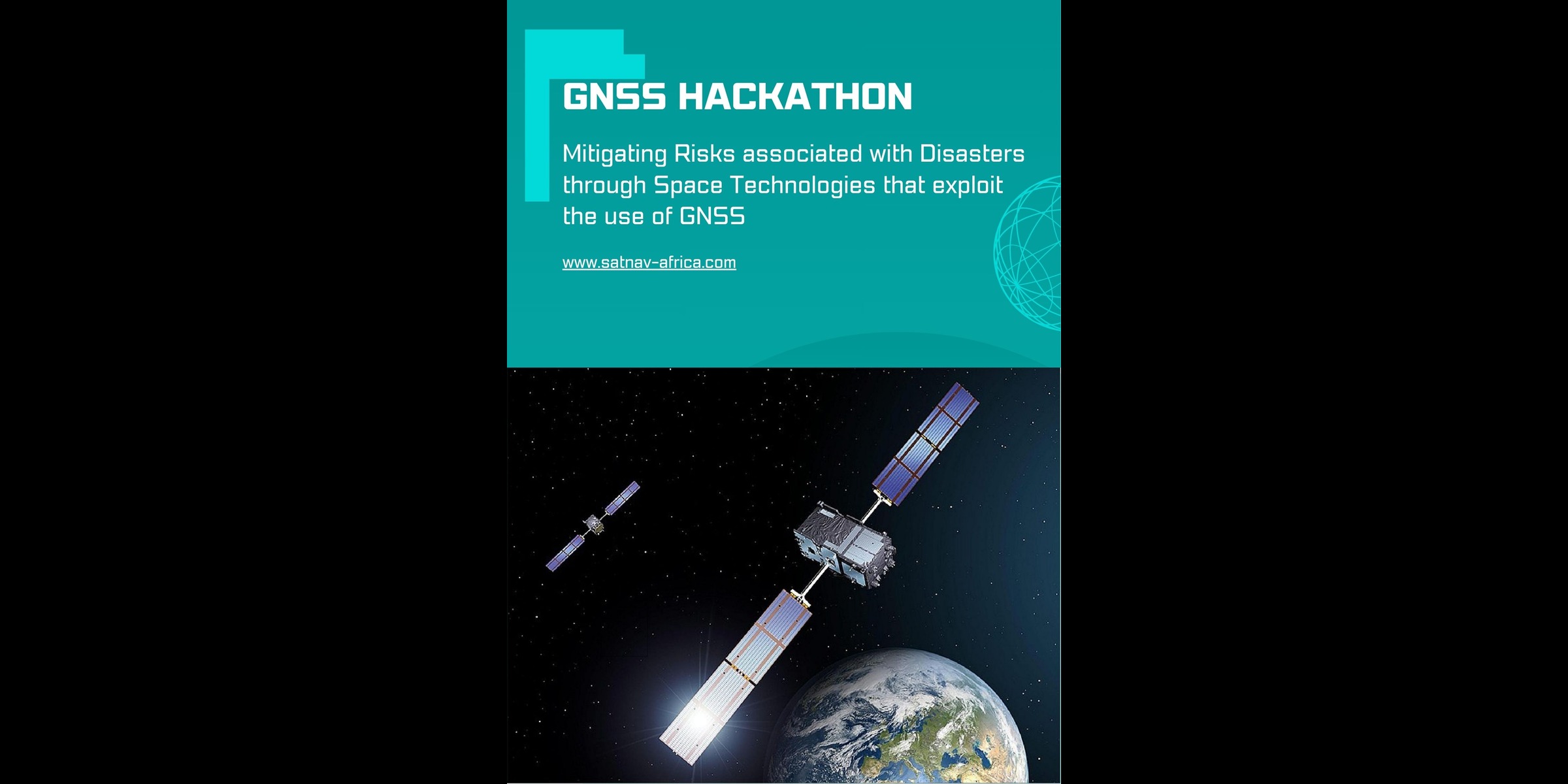
GNSS 4 Disaster Risk Reduction (G4D-RR) Hackathon
# **Introduction**
 Organizer SATNAV AFRICA JPO
Register · remaining
About this hackathon
# **Introduction**
The hackathon aims to develop innovative, technology-driven solutions that address real-world challenges arising from mitigating the risks associated with disasters. Participants will leverage space-based technologies, particularly GNSS applications, to create impactful solutions that support the mitigation of risks associated with disasters.
Guided by theme of the hackathon and its target areas, a number of areas of the challenges have been proposed and include:
# **Challenge I: Drones for Emergency Applications**
The recent proliferation of drones throughout the African continent offers a ray of hope to the over one billion people living on the continent. New unmanned aerial vehicle (UAV) technology can potentially solve some of the biggest challenges facing the region and be a major catalyst towards a future of prosperity, peace, and independence.
As parts of Africa continue to sort out the regulations and systems needed to support drone activities- both in the public and private spheres- drone technology promises to advance in the region at an astounding pace. Since the initial force behind the proliferation and advancement of drone technology was to leapfrog an inadequate infrastructure and get supplies to out of the way locations, the demand for nimble and fuel efficient cargo delivery options will no doubt continue to drive adaption and innovation The “Drones for Emergency Applications” challenge aims at encouraging the development of innovative solutions specifically targeting emergency applications. Participants shall be tasked to develop ideas/concepts, or design products, devices or services that use GNSS positioning data that aids in areas such as;
- Early Warning Services (EWS)
- Search and Rescue (SAR)
- Disaster risk reduction and Management.
# **Challenge II: Environmental monitoring**
Observing our planet from space offers an unprecedented opportunity to monitor changes on the Earth’s surface. Space technology allows us to identify patterns over time, understand trends, and monitor our planet to better manage, conserve, and adapt to our changing environment. Available estimates show that land degradation affects 46% Africa’s land area with at least 485 million (65%) people affected, which translates to US$9.3 billion annual cost. Additional estimates show that 75-80% of the continent’s cultivated area is reportedly degraded, with a loss of 30 to 60 kg of nutrients per hectare per year.
Monitoring of wetlands and water bodies in African is of high importance for the local population and for wetland ecology. It should be noted that Africa’s surface air temperature has been on increase thereby causing intense heat wave and resulting in a change in the climate. There is need to Implementing sustainable space based environmental monitoring capacity in Africa so as to ensure that the degradation of its land, water bodies is avoided.
The “Environmental monitoring Challenge” is looking for innovative solutions that use space data (GNSS and EO) within the domains of Environmental monitoring so as to answer the Environmental challenges that Africa faces. Participants are encouraged to submit solutions using Galileo and EO Data generated for the Africa continent as key enablers to:
- Environmental protection
- Intuitive waste management
- Environmental Sustainability
# **The criteria to be used by the judges :**
- **Originality**
The idea/solution must be original and should not be a copy of someone else’s idea/ solution/ product. The idea/ solution/ product can also be a new interpretation of an existing idea with a different application.
- **Sustainability**
Every solution should clearly articulate what benefits and impacts it will have on the environment, the company’s bottom line (whether reducing cost, or increasing profit), the welfare of the employees and customers, and how it can continue making a difference in the long term.
- **Significance**
When assessing the potential impact of a proposal, we evaluate the extent to which the project plan aligns with the primary goal of the Hackathon: increasing awareness and participation in endeavors aimed at enhancing service delivery, processes, and systems while effectively tackling significant challenges within specified categories. Additionally, we gauge the project's relevance by assessing its alignment with key challenges faced by enterprises in different industries.
- **Applicability and Transferability**
An essential element of this initiative is finding projects that can serve as inspiration to others in the different industries facing similar challenges or opportunities. The Hackathon intends to grow and promote innovation at the corporate and industry levels but also seeks to share models for innovative efforts. Therefore, we examine each proposal about relevant and broader application, adaptation, and transferability.
- **Market Potential**
Participants should present innovations that yield a notable boost in the adoption of satellite downstream services within diverse market segments. Whether in agriculture, transportation, telecommunications, or other sectors, submissions should showcase tangible benefits to users that will drive the uptake of satellite-based solutions. Entries will be evaluated based on their ability to effectively address market needs, accelerate the integration of satellite technologies, and catalyze transformative changes within the downstream ecosystem, as well as viability.
- **Impact**
We are looking for projects that will have long-term effects for companies and their operations. We look for projects that can potentially shake up organizations by implementing new ideas, creating new models of engagement, and transforming organizational culture. We take into account the project's potential for far-reaching impact and/or appeal to multiple stakeholders within and across organizations, as well as the measurability of market benefits, need, and future demand.
Each of the criteria segments will be scored out of ten and the final score will be an aggregated of each individual judge’s scores as well as the average of all the judge’s scores.
# Prizes to Winners
Up to Three winners shall be selected for the award of a prize of taking part in the SPACE STAR 2026 Conference.
The SPACE STAR 2026 Conference was the fourth conference organized by the Tunisian Ministry of Higher Education and Scientific Research to discuss Space Science, Technology, Applications & Regulation aspects. It was a scientific and technological event dedicated to space research and applications.
The conference is sponsored in part by the FACT Project (Fabrication and Applications of CubeSats in Tunisia), which is funded by the Tunisian Ministry of Higher Education and Scientific Research
It also aimed at encouraging networking and collaborations in space technologies, applications, and regulation. The areas of focus by the conference was in aspects of astronomy, remote sensing, satellite and novel space technologies.
Prizes - Participation in the SpaceSTAR 2026 Conference (to be held in Tunis, November 2026) and this shall include:
- Full Registration for the SpaceSTAR 2026 Conference
- Round-trip flights
- Daily Subsistence Allowance (DSA)
# Hackathon Resources
## Real-time datasets
Accessible through ArcGIS Living Atlas of the World
1. World Traffic Map: [https://arcg.is/1qDLvD](https://arcg.is/1qDLvD)
2. Environment
- Global Yearly Temperature Anomaly (1850 - present) [https://arcg.is/1jvfqS0](https://arcg.is/1jvfqS0)
- GEOGLOWS 2.0 ECMWF Streamflow Model (10-Day Forecast) [https://arcg.is/1nH0yj](https://arcg.is/1nH0yj)
- Live Stream Gauges [https://arcg.is/15zKr1](https://arcg.is/15zKr1)
- NOAA Coral Reef Watch (CRW) Virtual Stations [https://arcg.is/1equeG](https://arcg.is/1equeG)
- OpenAQ Recent Conditions in Air Quality [https://arcg.is/0uueuz](https://arcg.is/0uueuz)
3. Humanitarian/disaster related
- Recent Earthquakes [https://arcg.is/1j0D1e0](https://arcg.is/1j0D1e0)
- ACLED Conflict and Demonstrations Event Data [https://arcg.is/qey9P](https://arcg.is/qey9P)
- Active Hurricanes, Cyclones and Typhoons [https://arcg.is/0jDKqS](https://arcg.is/0jDKqS)
- Satellite (VIIRS) Thermal Hotspots and Fire Activity [https://arcg.is/miur8](https://arcg.is/miur8)
4. Citizen Science
- Open Street Map layers for Africa [https://livingatlas.arcgis.com/en/browse/?q=osm%20africa#d=2&q=osm+africa](https://livingatlas.arcgis.com/en/browse/?q=osm%20africa#d=2&q=osm+africa)
- iNaturalist Observations [https://arcg.is/10ybmP1](https://arcg.is/10ybmP1)
- Overture foundation’s Open 3D Buildings [https://arcg.is/0SPGuq0](https://arcg.is/0SPGuq0)
## Other Real time datasets
1. Port Watch data from IMF [https://portwatch.imf.org/4](https://portwatch.imf.org/4)
2. Mobility Tracking data from IOM [https://dtm.iom.int/component/mobility-tracking?page=4](https://dtm.iom.int/component/mobility-tracking?page=4)
3. FAO Event Visualization in emergencies [https://data-in-emergencies.fao.org/pages/diem_eve](https://data-in-emergencies.fao.org/pages/diem_eve)
4. Market prices for commodities [https://data.humdata.org/dataset?dataseries_name=World+Bank+Group+-+Real+Time+Prices](https://data.humdata.org/dataset?dataseries_name=World+Bank+Group+-+Real+Time+Prices)
## Data Processing Platform
- The Africa GeoPortal ( [https://www.africageoportal.com/](https://www.africageoportal.com/) )
## Case studies
- [Above Health: The Allergy Clinic of the Future | The Pitch](https://www.thepitch.show/175-above-health-the-allergy-clinic-of-the-future)
- A great place to look for GNSS related case studies is this site that summarizes the top start-ups in Africaby industry [https://startuplist.africa/industries](https://startuplist.africa/industries)
# Get Involved
We are excited to announce the first hackathon organized by the SATNAV Africa Joint Programme, and invite those on the African continent to participate! The hackathon will be a virtual event where you have the chance to participate in a project proposed by one of your colleagues or by yourself. It does not matter if you are an engineer, sales representative, or marketer. In a hackathon, everyone is needed.
The hackathon's theme is - "Mitigating Risks associated with Disasters through Space Technologies that Exploit the use of GNSS"
Date: June to August 2026
Location: Virtual
Early pre-registration is encouraged
To be eligible for the submissions, bounties, and prizes , please register above.
## Hackathon Guides
1. **How to Submit Your Idea as a BUIDL on Dorahacks:** [https://www.youtube.com/watchv=pcs4cDEm3V4](https://www.youtube.com/watchv=pcs4cDEm3V4)
2. Submission Guide: [https://dorahacks.io/hackathon/hederahackafrica/submission-guide](https://dorahacks.io/hackathon/hederahackafrica/submission-guide)
# Master classes to Support Hackathon Preparation
1. Global Navigation Satellite Systems (GNSS) and their applications:
Knowledge about GNSS receivers, their data formats, and how GNSS can be integrated with Internet of Things (IoT) and Google applications.
2. Earth Observation - Applications ,concept and Fundamentals.
Tracks
General Track
# **Introduction**
Prizes
Project Prize
# **Introduction**
Schedule
Jul 28, 10:00 AM
Aug 30, 08:00 PM
Tags
Similar hackathons
 arm
armArm Create: AI Optimization Challenge
Online, Jun 04 - Aug 14, 2026

 National Tutoring Observatory
Trace the Ace
Join us on the K-12 AI Infrastructure Platform and predict the learning gains from a tutoring session measured by quiz performance in this tutoring outcomes prediction challenge
 Backblaze
Backblaze Generative Media Hackathon: Build with Genblaze on B2
Online, Jun 22 - Aug 03, 2026